When I think about integration, I naturally zoom in — APIs, flows, transformations, connectors. That’s the world I live in daily as an integration architect. A recent training made me realize I’ve been solving the right problems at the wrong level.
The course “Strategic Integration Design with DDD” by Karol Skrzymowski and Philipp Kostyra introduced me to a perspective I hadn’t fully articulated before: integration architecture is not system architecture. It’s ecosystem architecture. And that distinction changes everything.
The Level Shift: From System to Ecosystem
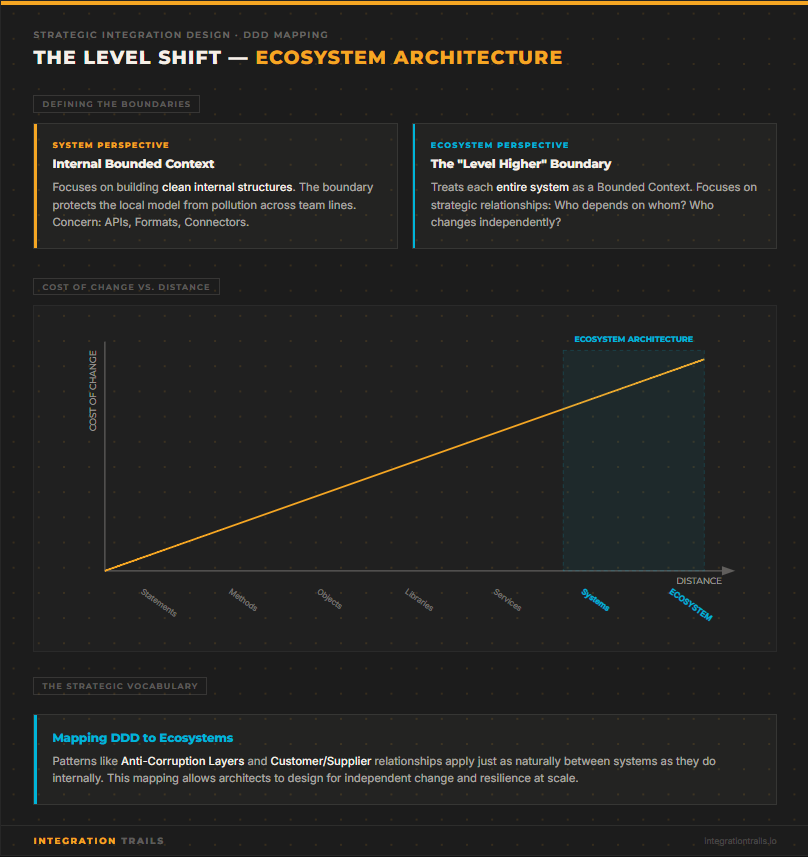
In Domain-Driven Design, a Bounded Context is a clearly defined boundary within which a model has a specific meaning and consistency. In system design, this helps teams build clean internal structures and avoid model pollution across team boundaries.
What this course applies is that exact thinking one level higher. Each system in your enterprise landscape can be treated as a Bounded Context. The entire landscape of interconnected systems becomes an ecosystem. And ecosystem architecture is its own discipline, with its own concerns, its own patterns, and its own failure modes.
I know, I know — this sounds like something everyone already does. In my experience, not really.
Most integration conversations I’ve been part of operate at the system level at best. We talk about APIs, message formats, connectors. We rarely step back and ask: what is the strategic relationship between these two systems? Who depends on whom? Who should be allowed to change independently?
DDD has a full vocabulary for exactly this — Conformist, Customer/Supplier, Anti-Corruption Layer, Shared Kernel — and these patterns apply just as naturally between systems as they do between internal bounded contexts. That mapping was the first thing that genuinely clicked for me.
Coupling Has More Dimensions Than I Thought
Once you accept that integration operates at the ecosystem level, coupling looks different. I was used to thinking about it as a spectrum — tight vs loose. The course reframes it across three dimensions:
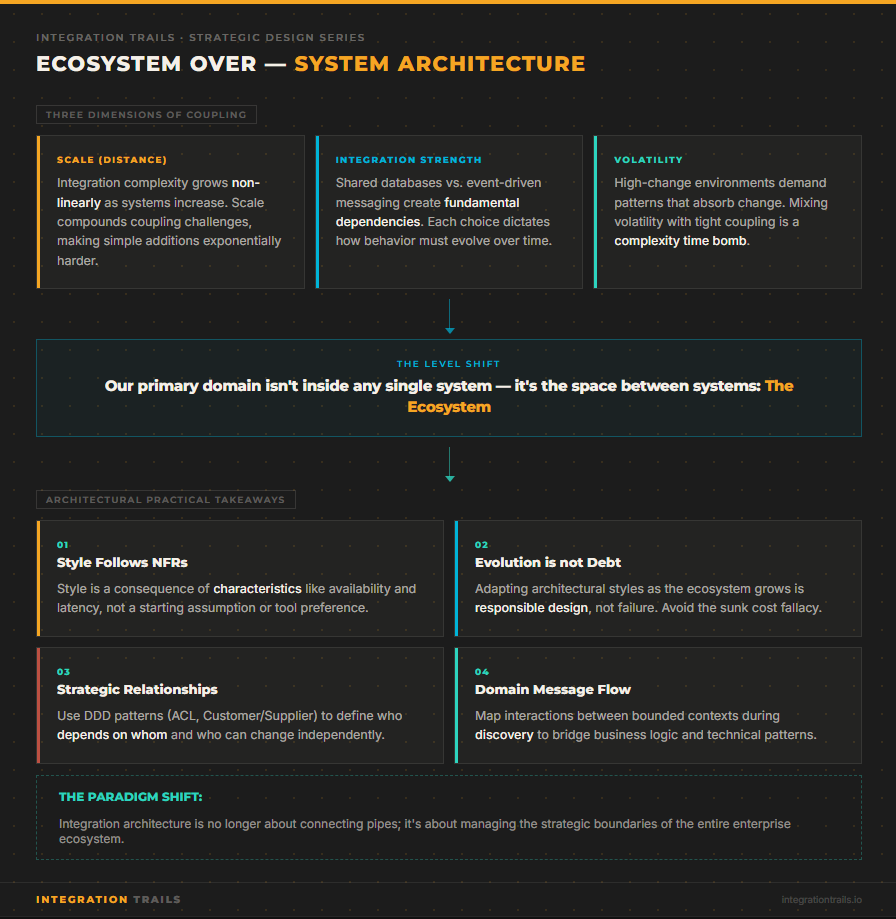
Scale (Distance) — how many systems are in your ecosystem and how spread out are they? A two-system integration has very different dynamics than a 30-system enterprise landscape. Distance coupling grows non-linearly as ecosystems scale. Add another layer of systems, and the coupling challenge doesn’t just add — it compounds.
Integration Strength — how tightly bound are systems at the data and behavior level? Shared databases, synchronous REST calls, and event-driven messaging create fundamentally different dependencies — with fundamentally different consequences when something needs to change.
Volatility — how often do connected systems change? A high-volatility environment where systems evolve constantly demands a very different approach than a stable, mature landscape where changes are infrequent and well-understood.
These three interact. A highly volatile ecosystem with many systems and tight integration is a complexity time bomb. I’ve seen this combination multiple times. It never ends quietly.
Architectural Style Follows Context, Not Preference
For years, I’ve watched integration decisions get made on inertia. API-led connectivity is the MuleSoft default, so it becomes the answer. Event-driven is the trend, so it gets proposed even where it doesn’t fit.
The course is explicit about something I knew intuitively but never had framed cleanly: architectural style is a consequence of non-functional requirements, not a starting assumption. The integration architecture should support the business processes — and the right way to determine how is through architectural characteristics: availability, scalability, data consistency, latency tolerance, and more.
If your client has three systems, moderate traffic, and a stable domain, point-to-point isn’t a failure. It’s appropriate. When the business grows, you re-evaluate. Changing architectural style as the ecosystem evolves isn’t technical debt — it’s responsible design. I’ve seen teams commit to API-led patterns before the business justified the operational overhead, and then spend years paying for complexity they didn’t need. The sunk cost fallacy hits hard in architecture.
Domain Message Flow: A Tool I Want on Every Project
One technique I hadn’t encountered before and haven’t seen used on any project I’ve worked on: Domain Message Flow.
The idea is to map interactions between bounded contexts — events, data, triggers — and use that map to identify appropriate integration patterns before writing any code. It sits naturally in the discovery phase, where it can drive conversations between business and technical stakeholders using a shared visual language.
What I find compelling is how it bridges the gap between “what the business does” and “how systems should be connected.” For once, a diagram I could actually show to a business stakeholder without losing them in the first thirty seconds. I haven’t had a chance to apply it on a live engagement yet, but I want to.
What This Changes for Me
Before this training, I understood DDD concepts at an intuitive level — I’d read Eric Evans, touched on bounded contexts through the MuleSoft Integration Architect curriculum. But I was applying these ideas inside systems, not across them.
The shift is this: as integration architects, our primary domain isn’t inside any single system. It’s the space between systems — the ecosystem. The boundaries, coupling decisions, and relationship patterns at that level are where our design choices have the most strategic impact.
I’m still figuring out how to bring this into projects where nobody asked for it. But I’m thinking about it differently now.
I was granted free access to this training in exchange for my honest professional review. The course is available at ddd.academy/strategic-integration-design-with-ddd
#BridgingTheGap #DDDAcademy #StrategicIntegrationDesign
📘 Enjoyed this deep dive?
IntegrationTrails.io is now live! Head over to app.integrationtrails.io where you'll find hands-on learning modules built from real-world integration practice and interactive DataWeave challenges to sharpen your skills beyond theory.
Prefer staying in the loop via email? Subscribe to the newsletter and never miss a new article or module.